The purpose of using rule of 3rds is to control the depth of field and fit the subjects head or an object within one of the sections created by the gridlines. These can be used in establishing shots and tilting shots. I didn't use the rule of thirds in my webisode because there was no depth of field within the footage and when it came to lining the script, we didn't use the rule of 3rds.
The 180 degree rule is seen in over the shoulder shots. The camera cannot break the line of continuity otherwise it would make it seem like they are looking at different places other than having a conversation. In our webisode in the scene where he was holding the drugs the person was facing in the opposite direction we broke the line of continuity causing my webserial to look bland and it won't make any sense.
The Master shot shows all of the characters captured within one scene for the duration for the purpose of telling the story. We didn't include a master shot in our webseries because all of the characters were scattered. It was a lot harder to tell the story since we didn't have a master shot.
The purpose of shot reverse shot is that it represents a conversation between two people through the use of two different camera angles and the camera switches between the two angles. We didn't have a shot reverse shot in our webisode because there was no conversation involved.
Depth of field forces the audience to focus on one subject whilst the background is blurry. We didn't use depth of field because the camera we were provided with didn't have the function to change focus on objects.
Establishing shots are shots of buildings, environment, or characters taken from a vast distance and is placed at the start of a film and its purpose is to begin the episode or the film. We used an establishing shot for our webserial which is the house.
Match on action is when one shot cuts to another for the purpose of creating mystery. We were unable to include a match on action in our webserial because we didn't have enough time to input more the editing techniques.
The purpose of movement in cameras is to show the audience the location or to find another position for the camera to settle in. In our webisode our zoom was overused and we also spent too much time panning one part of the untidy bedroom as the camera was moving left, right, and left again.
Lighting is an important part of film making because it allows the audience to see all of the action. We used the lights from the lampposts in the scene where the character was running away from the stalker to create a sense of realism for the audience.
The purpose of camera angles is to establish hierarchy within a range of shots. In our webisode, we used a low angle shot making the audience look at the hooded character which signifies that he is important in the story.
The purpose of shot types is to directly address the audience of the actor's body language or facial expression. In thrillers, you would abuse close up shots since they create suspense. However only had three close ups within our webisode which means that it lacks tension, suspense and mystery, and creativity.
The purpose of framing is to make room for the subject's head for the audience to look at the character's NVC. It may be useful for setting up close up shots. Framing was used in our webserial in the close up showing the scene where the character is sleeping on the bed, there was another scene with the character looking out of the window.
The purpose of building a sequence if shots is when many shots are combined to form a moving sequence. We didn't include that in our webisode because we didn't have the idea of building a sequence of shots in the lining of the script.
The purpose of blocking is to show relationship by the particular positioning two characters. There was no blocking in our webisode because there was no scene containing two people in order the examine the relationship.
Wednesday, 14 October 2015

Discussion of SCT Integrated In My Footage
We began filming with a master shot in order to capture all the characters and the environment. In single camera production this is important because master shots have the power to keep the story going and you at least have a movie. No master shot means no movie which goes to show how powerful master shots can be.

We followed the 180 degree rule in order to inform the audience that there is a character looking out the window. We made sure that it didn't cross the continuity. This is because in single camera productions the audience knows what is going on between the characters and they are facing in right direction as they are communicating instead of different areas.

We didn't have a conversation theme therefore, we didn't use shot/reverse shot.
Because we were shooting each shot individually we grouped all the close-ups on one camera and shot them all together. Because we were shooting each shot individually we were able to compose each shot using the rule of thirds to break the shot down in to 9 squares which will allow us to decide where to position the subject.
We used a low angle shot on the character getting out of bed to show that he is the main character and he is of importance to the story. because we were shooting with one camera, we had to set up these shots individually. This makes our webisode more single camera than if we had used multiple cameras.

During the shot of the room we used panning to express the condition of the room this creates a sense of mystery. This makes the audience curious since they would want to know why the room was in a mess.
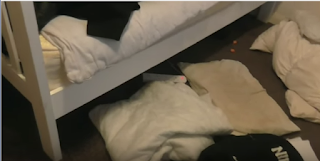
To involve the audience and create a sense of realism we used a close up shot of the drugs being held by the character's hand this shot is powerful as it informs the audience everything they need to know about the story.

We decided to use natural lighting from the lamppost to create suspense and to show that the character is running away from the stalker.

We built our scene using a variety of coverage shots for example the establishing shot on the house, the close up shot of the drugs and the character's face. This was in order to tell the audience that there is more you need to know about the story by doing this we had to edit our sequence of coverage shots together with our master shot. We used cuts between shots to introduce a new scene. There were no flash backs in our webisode because it is a linear narrative.

We followed the 180 degree rule in order to inform the audience that there is a character looking out the window. We made sure that it didn't cross the continuity. This is because in single camera productions the audience knows what is going on between the characters and they are facing in right direction as they are communicating instead of different areas.

We didn't have a conversation theme therefore, we didn't use shot/reverse shot.
Because we were shooting each shot individually we grouped all the close-ups on one camera and shot them all together. Because we were shooting each shot individually we were able to compose each shot using the rule of thirds to break the shot down in to 9 squares which will allow us to decide where to position the subject.
We used a low angle shot on the character getting out of bed to show that he is the main character and he is of importance to the story. because we were shooting with one camera, we had to set up these shots individually. This makes our webisode more single camera than if we had used multiple cameras.

During the shot of the room we used panning to express the condition of the room this creates a sense of mystery. This makes the audience curious since they would want to know why the room was in a mess.
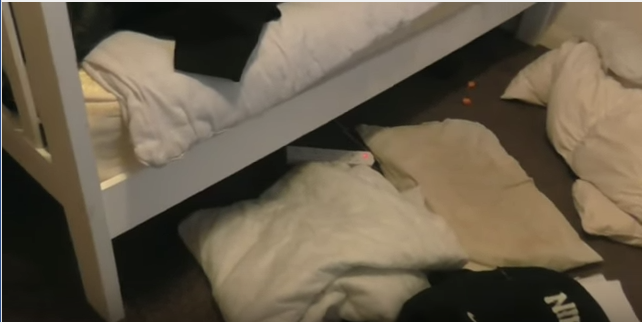
To involve the audience and create a sense of realism we used a close up shot of the drugs being held by the character's hand this shot is powerful as it informs the audience everything they need to know about the story.

We decided to use natural lighting from the lamppost to create suspense and to show that the character is running away from the stalker.

We built our scene using a variety of coverage shots for example the establishing shot on the house, the close up shot of the drugs and the character's face. This was in order to tell the audience that there is more you need to know about the story by doing this we had to edit our sequence of coverage shots together with our master shot. We used cuts between shots to introduce a new scene. There were no flash backs in our webisode because it is a linear narrative.
Tuesday, 13 October 2015
Webisode Production SCT
The advantage of depth of field is that it is a powerful editing technique which forces the audience to focus on one area of the scene. Shallow focus revolves around a smaller depth of field. Pull focus allows us to change the focus between two objects simultaneously changing the focus of the audience.
The advantage of rule of thirds is that it uses gridlines to break down the camera shot into 9 sections and within those sections you can fit in a title, or you can use the rule of thirds to control the depth of field in a way that it fits within one section of the gridlines. This editing technique is common in establishing and tilting shots.
The advantage of framing is that it sets up close-ups from which the audience can analyse the facial expression which makes them curious and forces them to wonder what they are looking at or why there are so tense. It is there to create dramatic affect by directly addressing the audience and creating meaning especially in thrillers.
The advantage of maintaining an audiences interest with a variety of coverage shots is that the audience can gather deeper knowledge of the story given that you have a master shot. The reason as to why the audience can gather deeper knowledge of the story is because you have more footage and more footage of the location means that there is more you can learn about the story. Coverage shots can be used creatively but it is slightly used more for creating meaning in thrillers.
The advantage of creating mystery and your suspense in your sequence is that it can create a puzzle in the minds of the audience depending on the pace of which the shots appear and disappear. By doing so this hooks the audience towards the movie and the audience can develop more interest. Coverage shots can be very engaging as long as you have a master shot because the use of imagination put into these coverage shots impress the audience and allow them to delve deeper into the story.
The advantage of having a small crew and a minimal amount of equipment is that when you are shooting your film, the chances of having equipment caught within the shot e.g. boom mic is very thin. Whereas having more equipment would mean that your single camera shots would have other equipment caught in the shot. Also, it is cheaper because you have minimal equipment in the location and you will spend less time in the editing suite since you only have one camera which has all the footage.
The advantage of controlling lighting in separate shots is that it reduces the impact of shadows on your camera shots. With balanced lighting, the audience is able to see the action or the scene which is currently taking place. With balanced lighting, there is no eye damage to the audience because the lighting is not too bright. Each environment has different lighting, it just there so that the audience can see everything that is going on. However, you can change the level of light for instance, make it darker to create an ominous environment.
The advantage of having multiple takes of the action is that when it comes to the point where you have to deal with your footage in the editing suite, the editor has a variety of takes of the action and thereby choose the best take of the action and you can get rid of the others you don't need.
The advantage of beginning with a master shot is that it captures every character in the story so that the audience can learn about each character via analysing their NVC, props, costume, and setting. Also the time the camera crew has within a location is very limited but if you at least have a master shot before you are removed from the location you can continue to tell the story. There is no story unless there is a master shot. As long as you have a master shot, you have a movie.
The disadvantage of breaking continuity is that the 180 degree rule is broken, which would lead to the audience being confused because for instance in an OTS shot, they don't know whether they are having a conversation or looking at random areas.
The disadvantage of required time on location to shoot multiple takes because of how many times they need to film a scene. The editor needs have more options therefore spending more time than the required and the chances are that you miss your deadline. In the media industry, if you miss your deadline, you will be sacked.
The disadvantage in the amount of footage to log and edit is that it is time consuming, meaning that you would have to spend more time in the editing suite. In the media industry the more time spend in the editing suite, the more money you have to spend.
The disadvantages of planning the number of shots in your storyboard is that when it comes planning the number of shots in your storyboard, you need to have a shot every time the scene changes Failure to do so would mean that the audience would be missing out on the important events of the film therefore it would paint a picture of the story in the minds of the audience and the element of suspense and mystery wouldn't be consistent.
The advantage of rule of thirds is that it uses gridlines to break down the camera shot into 9 sections and within those sections you can fit in a title, or you can use the rule of thirds to control the depth of field in a way that it fits within one section of the gridlines. This editing technique is common in establishing and tilting shots.
The advantage of framing is that it sets up close-ups from which the audience can analyse the facial expression which makes them curious and forces them to wonder what they are looking at or why there are so tense. It is there to create dramatic affect by directly addressing the audience and creating meaning especially in thrillers.
The advantage of maintaining an audiences interest with a variety of coverage shots is that the audience can gather deeper knowledge of the story given that you have a master shot. The reason as to why the audience can gather deeper knowledge of the story is because you have more footage and more footage of the location means that there is more you can learn about the story. Coverage shots can be used creatively but it is slightly used more for creating meaning in thrillers.
The advantage of creating mystery and your suspense in your sequence is that it can create a puzzle in the minds of the audience depending on the pace of which the shots appear and disappear. By doing so this hooks the audience towards the movie and the audience can develop more interest. Coverage shots can be very engaging as long as you have a master shot because the use of imagination put into these coverage shots impress the audience and allow them to delve deeper into the story.
The advantage of having a small crew and a minimal amount of equipment is that when you are shooting your film, the chances of having equipment caught within the shot e.g. boom mic is very thin. Whereas having more equipment would mean that your single camera shots would have other equipment caught in the shot. Also, it is cheaper because you have minimal equipment in the location and you will spend less time in the editing suite since you only have one camera which has all the footage.
The advantage of controlling lighting in separate shots is that it reduces the impact of shadows on your camera shots. With balanced lighting, the audience is able to see the action or the scene which is currently taking place. With balanced lighting, there is no eye damage to the audience because the lighting is not too bright. Each environment has different lighting, it just there so that the audience can see everything that is going on. However, you can change the level of light for instance, make it darker to create an ominous environment.
The advantage of having multiple takes of the action is that when it comes to the point where you have to deal with your footage in the editing suite, the editor has a variety of takes of the action and thereby choose the best take of the action and you can get rid of the others you don't need.
The advantage of beginning with a master shot is that it captures every character in the story so that the audience can learn about each character via analysing their NVC, props, costume, and setting. Also the time the camera crew has within a location is very limited but if you at least have a master shot before you are removed from the location you can continue to tell the story. There is no story unless there is a master shot. As long as you have a master shot, you have a movie.
The disadvantage of breaking continuity is that the 180 degree rule is broken, which would lead to the audience being confused because for instance in an OTS shot, they don't know whether they are having a conversation or looking at random areas.
The disadvantage of required time on location to shoot multiple takes because of how many times they need to film a scene. The editor needs have more options therefore spending more time than the required and the chances are that you miss your deadline. In the media industry, if you miss your deadline, you will be sacked.
The disadvantage in the amount of footage to log and edit is that it is time consuming, meaning that you would have to spend more time in the editing suite. In the media industry the more time spend in the editing suite, the more money you have to spend.
The disadvantages of planning the number of shots in your storyboard is that when it comes planning the number of shots in your storyboard, you need to have a shot every time the scene changes Failure to do so would mean that the audience would be missing out on the important events of the film therefore it would paint a picture of the story in the minds of the audience and the element of suspense and mystery wouldn't be consistent.
Friday, 9 October 2015
Monday, 5 October 2015
Single Camera Techniques (Google Docs)
https://docs.google.com/document/d/1RlyD5RvqpVhqh10oL6w_43jaKa_pxHzWyzMd3sUKuaE/edit?ts=5611a3d2
https://docs.google.com/document/d/1RlyD5RvqpVhqh10oL6w_43jaKa_pxHzWyzMd3sUKuaE/edit?ts=5611a3d2
Thursday, 1 October 2015
Pre-Production Report On My Web Serie
In this report I will be talking about the crucial aspects and the requirements needed to produce my web-serial.
The first requirement is the budget requirement which consists of paying for transport, camera equipment, camera crew, star power, and the editing suite 5. The equipment is borrowed from our college which is Christ The King in the Sidcup site which means that we don't have to spend any money. We also have access to the editing suite for which we will use to add dramatic effects to my episode. The type of production we will be using is single camera production.
We will have many more locations to shoot my episode. So in summary, the costs are covered by the college and any footage used to form my episode is under the ownership of the college. A percentage of the budget would go towards consumables such as food and drinks which will be provided within the session given the schedule.
How we are going to search for star power is that I will contact my peers from outside of college using my phone to see if they are available to star in my episode for the following days. In the media industry it would be expensive to include famous actors to star in your show. However, I will be looking for young actors who are willing to work for free.
In the film industry you would have to pay in order to transport your equipment it would cost around £1350 if you paid for bikes and taxis as a form of transport for your equipment. However, we will be using public transport and it is free as long as we have our oyster cards to prevent us from paying for bus passes.
The props I will be using for my pitch is a mask, someone's wallet showing ID, a shiv, and blood bag. It usually costs around £500 for props but I already have the props needed for my episode, I won't be spending any money on props. I plan to finish my project before the deadline so we can use the time to deal with surplus footage in the editing suite.
In order to achieve the objectives set, I must organise a timetable in advance and inform my crew so that they know when to attend. According to post-production, the date will be organised and everyone will need to be early so that we can make changes to the footage and simultaneously working at a moderate pace. It would normally cost £550 for editing in the editing suite or studio. However, we are using the computers in the college to edit our footage meaning that we don't have to pay a thing.
According to the size of my team, there will be a maximum of three people, two of them will be actors and one of them will be behind the camera filming, but each person in our group will have an opportunity to practice different roles to see if they have the posture and facial expression suitable enough fit with the role. In the industry the production crew is funded therefore they have the right to use copyrighted music which means that the have to pay money to whoever owns the song. However we will be free riders and download the music suitable for my episode free from any charges and constraints.
I have chosen my locations for my episode which is an estate, a street, and a building. Generally, it would cost £1800 on location fees. If the director wanted his film to be set in a bleak house, then it would cost £200,000 to shoot and film in the bleak house. The camera crew would have a limited time on capturing various parts of the locations so they have to get as much footage of the location as possible before they are removed from the site, fail to acquire sufficient footage, the money spent on the camera crew would be wasted and then they will be sacked by the director. However we are using college equipment and as a bonus, we use the locations for free but we still have to use our time wisely.
Subscribe to:
Posts (Atom)